
Master’s Degree in
Design: methods
and explorations
Federal SEP RVOE No. 20262558 (June 26, 2026)
Blended Learning – Av. Constituyentes 455, Col. América, Mexico City
Home | August 9, 2027
End Date | June 29, 2029
Duration | 4 semesters
Schedule | Tuesdays and Wednesdays from 6:00 p.m. to 10:00 p.m.
In-person and online classes
+1 workshop per semester, company visits, and design festivals
Federal SEP RVOE No. 20262558 (June 26, 2026)
Blended Learning – Av. Constituyentes 455, Col. América, Mexico City
Home | August 9, 2027
End Date | June 29, 2029
Duration | 4 semesters
Schedule | Tuesdays and Wednesdays from 6:00 p.m. to 10:00 p.m.
In-person and online classes
+1 workshop per semester, company visits, and design festivals
Forma parte de nuestra #Comunidad Creativa
The Master in Design: Methods and Explorations is a unique program that integrates academic research and professional practice. Design is today a strategic and transversal activity for organizations that seek to innovate and generate value. This postgraduate program trains leading and versatile professionals through a combination of advanced design methodologies, research practices, information design, technological creativity and storytelling, tools applicable to design projects in corporate, social and entrepreneurial environments.
- Comprehensive professional training: Development of skills in creativity, management, teaching and strategic thinking.
- Advanced design solutions: Design and research methods to address complex challenges in diverse contexts.
- Complex creative skills: Practice in data visualization, storytelling, creative technologies and other key skills.
- AI from a critical perspective: Practical exploration of its capabilities in relation to design, as well as the dominant industry discourses and their costs, harms and benefits.
- Links with the professional sector: Projects developed with national and international companies and universities.
Forma parte de nuestra #Comunidad Creativa
Curriculum
Who is it intended for?
- Design, architecture and communication professionals as well as entrepreneurs committed to innovation, leadership in creative projects, sustainability and social impact.
- Individuals seeking to expand their professional horizons by exploring advanced design methodologies and acquiring research, teaching, management and leadership skills.
What kind of jobs can you do?
- Graduates will be versatile professionals with expertise in innovative design methodologies to address complex problems in business, social and public sectors.
- They will be able to integrate specific skills from different professional fields with general design competencies to lead multidisciplinary teams.
- They may work as design directors, product design managers, strategic design consultants or design research coordinators.
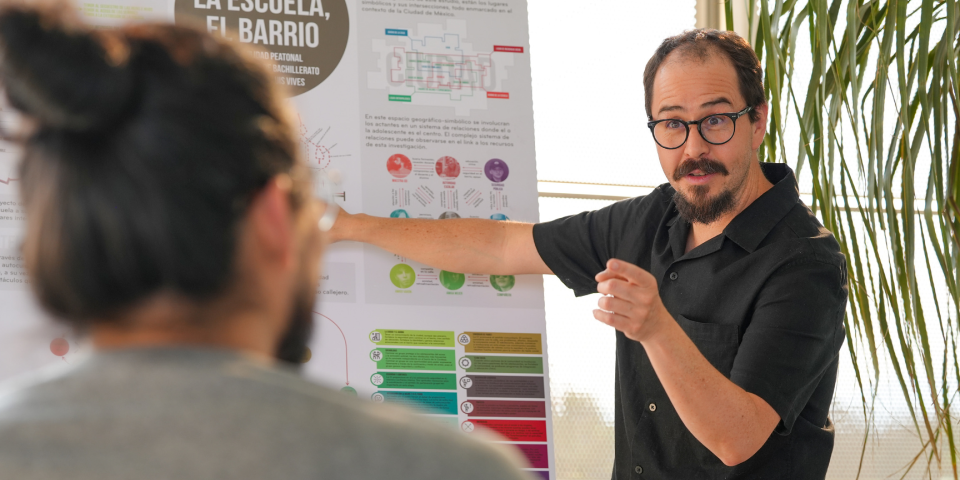
 Jorge Camacho : Director
Teachers
 Karla Paniagua
Ph.D. in Transdisciplinary Studies of Culture and Communication; M.A. in Social Anthropology. Co-editor-in-chief of CENTRO’s journal *Economía Creativa*. Feature writer, columnist, and author of four books. Regional editor for Latin America of the *Journal of Future Studies* (Tamkang University). Co-director of the UNESCO Chair on Design Methods for Democratic Access to the Imagination of the Future.
Master in design studies and industrial designer. Consultant and workshop leader in creative thinking, co-creation tools, design thinking, design sprints and problem solving. He collaborates with companies and educational institutions designing experiences and facilitating workshops on creative thinking, design methods and creative processes for complex problem solving.
 Paulina Cornejo
Innovation strategist with 18 years of experience designing creative concepts, educational models and innovation projects for entrepreneurs, companies, social organizations and educational institutions with an interdisciplinary approach (branding, marketing and communications, experience design and futures design). Co-founder of LUAN Emotional Museum and strategic designer at Actloop. She was Head of the Center for Educational Innovation at Universidad Panamericana.
Frequently Asked Questions
and the admissions process
for international students
Why CENTRO?
- Connection to an international network of experts.
- Program to Promote Excellence: Take courses from other graduate programs at no cost to expand your knowledge in other areas
of interest. - Collaborations with CENTRO's Center for Research on the Creative Economy (CIEC), which disseminates scientific content and publishes the academic journal *Economía Creativa*.
- Professional collaborations with CENTRO Estudio, a program that connects the graduate student community with industry on real-world projects.
Why CENTRO?
- Participation in CENTRO Conecta, a "
" event designed to connect with companies seeking creative talent. - A campus with 17 workshops for industrial design, textiles and fashion, technology, screen printing, and more; 4 screening rooms; 4 computer labs, 1 photography lab, and 1 lighting lab; 2 film and television forums; 13 editing stations; 3 audio booths; 1 ABB robotic arm; 1 Digital Maker Lab; the largest motion capture system in Latin America with 24 infrared cameras; and 1 art gallery.
Why CENTRO?
- Connection to an international network of experts.
- Program to Promote Excellence: Take courses from other graduate programs at no cost to expand your knowledge in other areas of interest.
- Collaborations with CENTRO's Center for Research on the Creative Economy (CIEC), which disseminates scientific content and publishes the academic journal *Economía Creativa*.
- Professional collaborations with CENTRO Estudio, a program that connects the graduate student community with industry on real-world projects.
- Participation in CENTRO Conecta, a networking event with companies seeking creative talent.
- A campus with 17 workshops for industrial design, textiles and fashion, technology, screen printing, and more; 4 screening rooms; 4 computer labs, 1 photography lab, and 1 lighting lab; 2 film and television forums; 13 editing stations; 3 audio booths; 1 ABB robotic arm; 1 Digital Maker Lab; the largest motion capture system in Latin America with 24 infrared cameras; and 1 art gallery.


Frequently Asked Questions
1. Do you offer scholarships and financial aid?
CENTRO Scholarship: You can apply once you have received your admission letter. A socioeconomic assessment (for a fee) is conducted, and an external company evaluates your need for financial aid. Based on that information, the scholarship committee determines the percentage. The decision is final.
CENTRO Alumni Scholarship: 30% for graduates of both undergraduate and graduate programs.
Funding: We work with Laudex to secure funding for the programs. They conduct a risk assessment and determine the percentage of funding to be provided. Laudex Advisor Contact Information: Linda Granados | 55 7672 2250 | linda.granados@laudex.mx
2. Are there any early payment benefits?
Get 10% off your first tuition payment if you enroll by April 20 for the August graduate programs and by October 20 for the January graduate programs.
6% off your first tuition payment or the full semester/quadrimester fee if you enroll by June 15 for the August graduate programs and by December 15 for the January graduate programs.
3. Can I enroll without a bachelor's degree?
It is a mandatory requirement of the SEP to hold a bachelor’s degree in order to enroll in a graduate program. If you are still in the process of obtaining your degree, you may enroll by submitting a certificate from your university stating that you have successfully completed 100% of your course credits and that your degree is in process.
4. Can I earn a degree through a CENTRO graduate program?
Yes, you can do so by submitting a letter from your university stating that you have successfully completed 100% of your bachelor’s degree credits and authorizing this degree conferral process.
5. Why do I need to have a good command of English?
6. What are the requirements for enrolling in a graduate program?
To begin the admissions process, you will need: A bachelor’s degree (if you are still working toward your degree, you have the first semester to submit your diploma), a statement of purpose, a completed admission form with your information, a resume, an interview with the program directors for evaluation and acceptance, preferably professional experience, and a good command of English (required for some programs).
Some graduate programs will have specific requirements related to knowledge of software programs or having a portfolio. Your advisor will inform you of these requirements.
To begin the registration process, you must submit the following documents: Letter of Acceptance, Birth Certificate, Bachelor’s Degree Certificate, Bachelor’s Degree Diploma, CURP, and Professional License.
7. What is the admissions process like?
Once you have met all the requirements listed in the previous points, you must undergo an interview with the administration or program coordinators of the program you are interested in. If you are admitted to the program, we will provide you with your acceptance letter, and you can begin the enrollment process by paying the first tuition installment and submitting the required documentation. At this point, you can begin the scholarship application process, if necessary. Once you have completed the admission forms, made the payment, and submitted the required documentation, you will be officially enrolled in the graduate program.
8. What is the admissions process for international students?
You can choose to enroll in the program and earn a degree from CENTRO, or have your studies recognized to obtain a degree from the SEP.
Check out the FAQs for foreigners here
9. Can I take courses from other graduate programs?
CENTRO has developed the “Promoting Excellence” program, which allows graduate students to take courses from other programs to enrich their education at no additional cost.
Specializations: 2 courses per semester/quadrimester (4 in total for the program).
Master’s Programs: 2 courses per semester/quadrimester (6 in total for the program).
To be eligible for this benefit, you must meet certain academic prerequisites and have no outstanding financial obligations.
10. What is the difference between a specialization and a master's degree?
A Specialization is a graduate program designed to provide in-depth study in a specific area of knowledge and to develop skills for better job performance. Upon completion, you will receive an academic diploma as a Specialist awarded by the SEP. The average duration is one year.
A master’s degree is the final stage of formal education—a graduate program that provides academic, theoretical, and practical training superior to that of a specialization. It requires analytical and interpretive skills to formulate concepts and develop arguments. Upon completion, you will receive a Master’s degree awarded by the SEP. The average duration is 18 months or between 400 and 500 hours of instruction.